What is lymphedema?
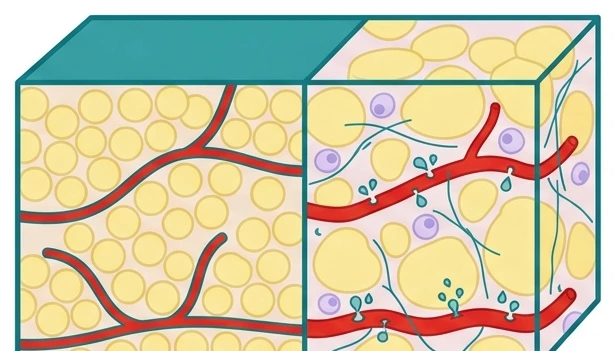
The lymphatic system is a second drainage network that collects fluid and protein waste that accumulate between tissues and returns them to the circulation. When this network does not work well enough, protein-rich fluid accumulates in the tissue. Over time the accumulated protein triggers an inflammatory response, fatty tissue increases and the tissue hardens. Lymphedema is therefore not just water retention but a progressive structural process.
Early treatment prevents lasting swelling.
Swelling is most often seen in the arm or leg. Initially it increases at the end of the day and decreases in the morning; in later stages it no longer goes away even when the leg is raised.
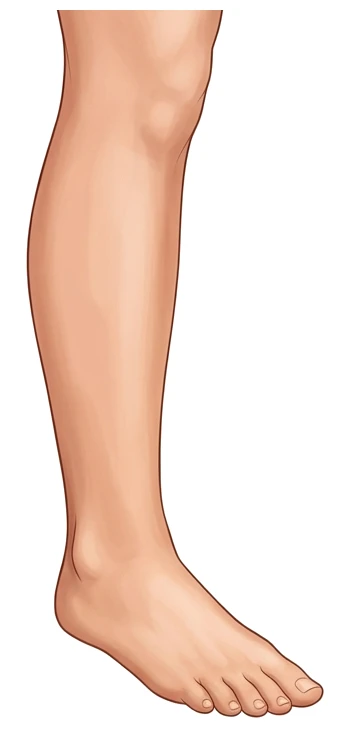
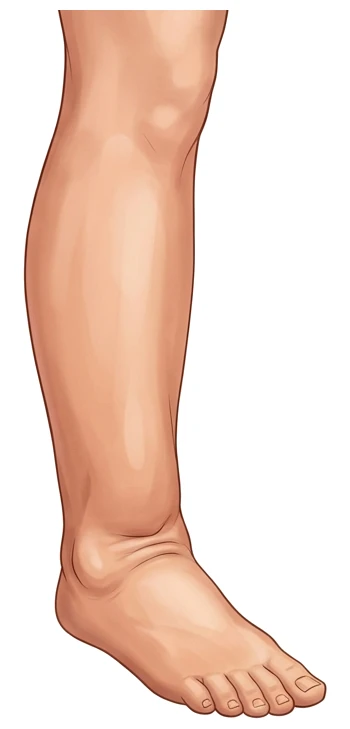
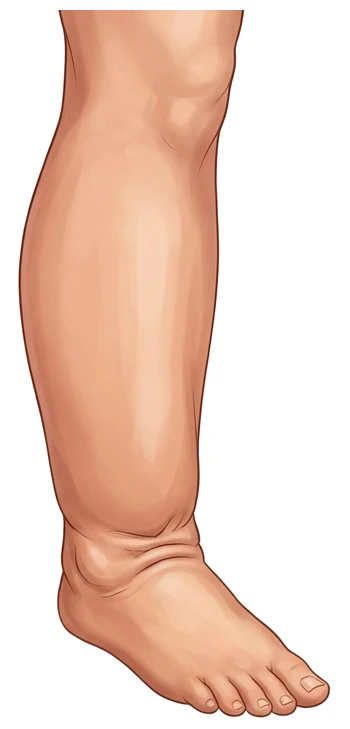
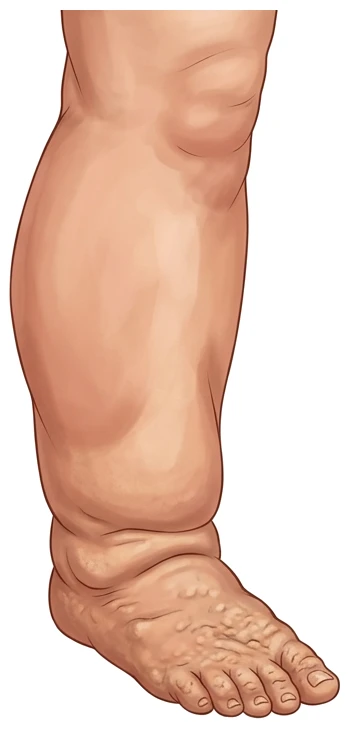 1
1Stage 0-1
The swelling is mild; pressing with a finger leaves a dent.
- Soft swelling of the ankle and top of the foot
- Decreases when the leg is raised
Stage 2
The tissue begins to harden; the swelling does not go away with rest.
- Deep skin folds at the ankle
- Toes look angular (Stemmer sign)
Stage 3
Marked enlargement and skin thickening.
- Firm swelling that does not leave a dent
- Deep skin folds
Stage 3, advanced
An appearance similar to elephantiasis.
- Warty, coarse skin changes
- The risk of infection increases; the success of treatment depends on starting early
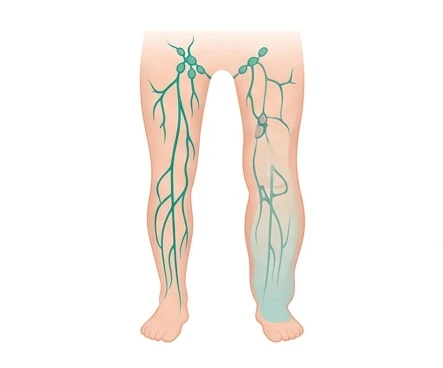
Symptoms
- Usually one-sided, progressive swelling of the arm or leg
- Swelling of the top of the foot and the toes as well
- Shoes, rings, watches or a wristwatch beginning to feel tight
- A feeling of heaviness, tightness and fullness in the limb
- Thickening and hardening of the skin, and over time an orange-peel appearance
- Recurrent cellulitis attacks: redness, rising warmth and fever
What causes it?
Lymphedema is divided into two groups, depending on whether the lymphatic system was inadequate from birth or was damaged later.
Primary lymphedema
It results from lymph vessels that are few in number or non-functional from birth. It can begin at birth, during puberty or in adulthood. It is more common in women and usually affects the legs.
Secondary lymphedema
This is the more common group. It results from damage to the lymph pathways later in life:
- Removal of lymph nodes during cancer surgery, especially in the arm after breast cancer
- Radiotherapy applied to the area
- Recurrent cellulitis and erysipelas attacks
- Severe trauma, burns and extensive surgical scars
- Prolonged venous insufficiency straining the lymphatic system (phlebolymphedema)
- Advanced obesity
Proportion of women who develop arm lymphedema after breast cancer treatment
%0
Roughly one in every five women.
Pooled result of prospective cohort studies. The risk is higher in patients whose axillary lymph nodes were completely removed.
DiSipio T et al. Incidence of unilateral arm lymphoedema after breast cancer: a systematic review and meta-analysis.
Lancet Oncol 2013;14(6):500-515. doi:10.1016/S1470-2045(13)70076-7
How is it diagnosed?
The diagnosis is made largely from history and examination. When the swelling started, whether it is one-sided or two-sided, and any history of surgery and radiotherapy are key. The examination assesses the Stemmer sign, whether the swelling leaves a dent, and skin thickness. Circumference measurements of both limbs are recorded; the response to treatment is followed with these measurements.
To rule out other causes of swelling, the venous system is evaluated with imaging (Doppler ultrasound, CT/MR venography), and oedema from the heart, kidneys, liver and thyroid is investigated. In selected cases where the diagnosis remains uncertain, lymphoscintigraphy can directly show lymph flow.
Treatment
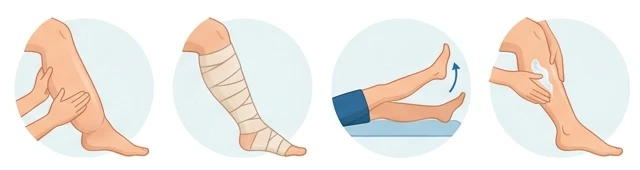
The foundation of treatment is not surgery but regular, continuous complex decongestive physiotherapy. It is effective when all four components are applied together; if one is omitted, results cannot be achieved.
- Manual lymphatic drainage. A specialised technique performed with very light pressure in a specific sequence. It is completely different from classic massage and must be performed by a trained physiotherapist.
- Compression. During the intensive phase, multi-layer bandaging is used; during the maintenance phase, custom-made compression garments are used. It is the most decisive component of treatment.
- Exercise. Muscle pump exercises performed under compression increase lymph flow.
- Skin care. Moisturising and preventing cracks and wounds reduces cellulitis attacks. These attacks cause new damage to the lymphatic system each time.
In selected patients who do not respond to physiotherapy, surgical options are considered. In lymphaticovenous anastomosis, a blocked lymph channel is connected to a neighbouring vein; in vascularised lymph node transfer, a lymph node is transplanted from another area. In advanced stages, specialised liposuction may be used to reduce the volume of hardened tissue. These procedures do not replace compression therapy; they are carried out alongside it.
How it differs from lipedema
The two conditions are often confused, yet their treatments differ. Lipedema is symmetrical in both legs, the top of the foot is spared, and pain on touch is prominent. Lymphedema is usually one-sided, involves the top of the foot, and the Stemmer sign is positive. The two can also coexist in the same patient; this is called lipo-lymphedema. For details, see the lipedema page.
Frequently asked questions
Does lymphedema ever go away completely?
Lymphedema is a chronic condition and cannot be completely eliminated with current methods. However, with regular treatment the swelling can be greatly reduced, its progression can be halted and infection episodes can be prevented. Treatment started early gives a marked improvement.
Will I have to wear compression stockings for life?
During the intensive phase, bandages are used; afterwards, custom-made compression garments are used. Because the swelling returns when compression is stopped, use is usually continuous. Garments lose their elasticity and should be replaced every six months.
My arm swelled after breast cancer surgery. Is this lymphedema?
Swelling of the arm after removal of the lymph nodes in the armpit or radiotherapy to the area is the most common cause of secondary lymphedema. It can appear months or even years after surgery. A feeling of heaviness in the arm, and rings or watches feeling tight, may be the first warning.
What is the difference between lymphedema and lipedema?
Lipedema is symmetrical in both legs, the top of the foot is spared, and pain on touch is marked. Lymphedema is usually one-sided, involves the top of the foot, and the skin over the toes cannot be lifted. This finding is called the Stemmer sign and is the most practical examination sign for distinguishing the two.
My swollen leg became red and I have a fever. What should I do?
Sudden redness, rising warmth, pain and fever in an area affected by lymphedema suggest cellulitis, an infection of the skin and tissue beneath it. This requires antibiotic treatment without delay. Episodes should not be postponed, because each one causes new damage to the lymphatic system.
Can I have a massage on my swollen leg?
Classic massage is not suitable for lymphedema and may even cause harm. The method that should be used is manual lymphatic drainage, a specialised technique performed with very light pressure in a specific sequence. It should be performed by a physiotherapist trained in this technique.
Examination and appointments. Patients from Bitlis, Tatvan, Van, Muş and the surrounding area are examined at the Cardiac and Vascular Surgery Outpatient Clinic of Tatvan State Hospital. Appointments are made through MHRS (Türkiye's national hospital appointment system); details are on the Appointments and Contact page.
Related pages
 LipedemaSymmetrical, painful thickening of both legs
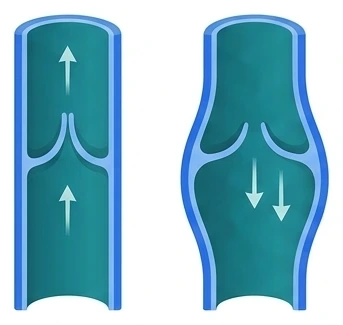 Varicose vein treatmentSwelling that increases in the evening and eases in the morning
 Deep vein thrombosisSwelling that develops over days in one leg