
A symbiotic life
The gut flora (microbiota) consists of bacteria and other microorganisms living in our digestive tract. This partnership works both ways: we give them a warm, nutrient-rich environment; they process the fibres our enzymes cannot break down, contribute to the production of some vitamins, and make it harder for harmful microbes to settle. In biology this is called symbiosis, a shared life based on mutual benefit.
The number of bacteria living in our body is about
0trillion
This is on the same level as the roughly 30 trillion human cells in our body; the vast majority of the bacteria live in the colon.
Value calculated for a 70 kg reference adult; the total weight of the bacteria is about 0.2 kg.
Sender R, Fuchs S, Milo R. Revised estimates for the number of human and bacteria cells in the body. PLoS Biol 2016;14(8):e1002533.
doi:10.1371/journal.pbio.1002533
We feed them, they feed us.
From fibre to butyrate
The fibres in vegetables, fruit, legumes and whole grains pass undigested through the small intestine and reach the colon. Here, gut bacteria ferment these fibres and produce substances called short-chain fatty acids: acetate, propionate and butyrate. Butyrate is produced especially by certain bacterial species such as Faecalibacterium and Roseburia.

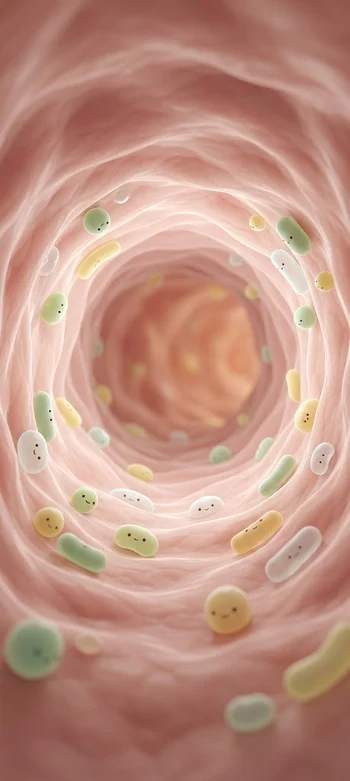
It all starts on the plate. We cannot digest the fibre in vegetables, legumes, oats and fruit; it is food for our gut bacteria.
Our neighbours in the colon. Trillions of bacteria live along the gut wall and wait for the fibre that reaches them.
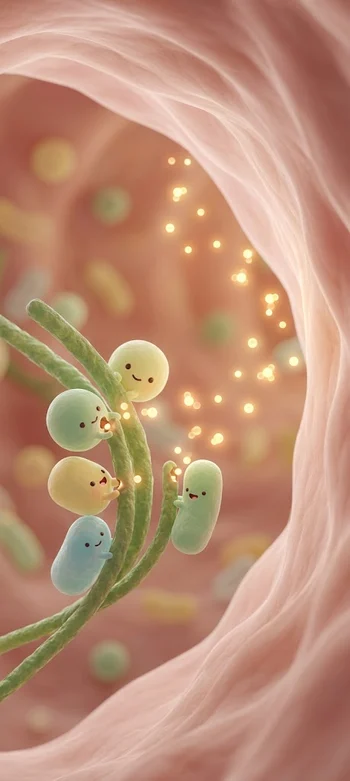
Butyrate production. Bacteria ferment fibre to produce butyrate. Butyrate passes directly into the cells of the gut wall and nourishes them.
What is butyrate good for?
The cells lining the colon (colonocytes) get most of their energy from butyrate. Enough butyrate helps keep the cells that form the gut wall healthy and preserves the tight junctions between them; this way the gut wall works as a strong barrier.
About
0%
of the energy used by colon cells comes from butyrate.
Laboratory measurement in cells obtained from the human colon; with butyrate as the only fuel, 73% of oxygen consumption in the ascending colon and 75% in the descending colon was attributable to butyrate.
Roediger WE. Role of anaerobic bacteria in the metabolic welfare of the colonic mucosa in man. Gut 1980;21(9):793-798.
doi:10.1136/gut.21.9.793
Butyrate also has effects on the immune system. Mouse studies have shown that butyrate produced by gut bacteria increases the formation of regulatory T cells, which balance the immune response. The clinical importance of these effects in humans is still being investigated.
The gut-brain axis
The gut and the brain communicate constantly. This two-way connection is called the gut-brain axis, and the gut flora is an important part of this conversation. Communication happens through several routes:
- Vagus nerve: This nerve, running from the gut to the brain, passes changes in the gut directly to the brain.
- Bacterial products: Short-chain fatty acids such as butyrate enter the blood and can affect the nervous system indirectly.
- Immune system: Immune cells in the gut interact with the flora and thereby influence the level of inflammation in the body and, in turn, the brain.
- Hormones and signalling molecules: Most of the body's serotonin is made in the gut, and some gut bacteria increase this production. Serotonin in the gut does not pass directly to the brain; it regulates gut movements and the signals travelling from the gut to the brain.
Animal studies show that the flora can influence the stress response, anxiety and social behaviour. In humans these relationships have been studied only recently, and the results are not yet clear enough to turn into treatment.
Butyrate and social dominance: the rat study

Gut bacteria may even influence behaviour. In a study published in 2022, the gut flora of rats holding a dominant (leader) position in the group was found to differ from that of rats remaining in the background. Most of the bacteria that stood out in the flora of the winning rats were butyrate-producing species. Rats whose flora was disrupted fell back; when their guts were repopulated with a single butyrate-producing bacterial species (Clostridium butyricum), they regained their dominant position. These findings belong to an animal experiment; a similar effect has not been shown in humans.
Foods containing butyrate: butter and ghee
Butyrate takes its name from butter (Latin butyrum: butter). About 4% of the fatty acids in milk fat are butyric acid; this is why butter and the clarified butter made from it (ghee) are the main foods that contain butyrate directly. Ghee is obtained by boiling butter made from cow or buffalo milk and removing its water and milk proteins.
Even so, the main source of the butyrate that nourishes the colon is the butyrate that bacteria produce from fibre. Because butter and ghee are rich in saturated fat, they should be eaten in moderation; they do not replace a fibre-rich diet.
How do we support the flora?
- Eat a variety of vegetables, fruit, legumes and whole grains every day; variety in fibre supports variety in bacteria.
- Oats, lentils, chickpeas, beans, onions, leeks and garlic are rich in the fibres that butyrate-producing bacteria like.
- Resistant starch, formed in potatoes, rice and pasta that have been cooked and cooled, is also fermented by bacteria.
- Use antibiotics only when a doctor recommends them and for the recommended duration; unnecessary antibiotics can disturb the flora.
- Increasing fibre suddenly can cause gas and bloating; raise the amount gradually over a few weeks and drink plenty of water.
References
- Sender R, Fuchs S, Milo R. Revised estimates for the number of human and bacteria cells in the body. PLoS Biol 2016;14(8):e1002533. doi:10.1371/journal.pbio.1002533
- Roediger WE. Role of anaerobic bacteria in the metabolic welfare of the colonic mucosa in man. Gut 1980;21(9):793-798. doi:10.1136/gut.21.9.793
- Louis P, Flint HJ. Formation of propionate and butyrate by the human colonic microbiota. Environ Microbiol 2017;19(1):29-41. doi:10.1111/1462-2920.13589
- Furusawa Y et al. Commensal microbe-derived butyrate induces the differentiation of colonic regulatory T cells. Nature 2013;504(7480):446-450. doi:10.1038/nature12721
- Wang T et al. Gut microbiota shapes social dominance through modulating HDAC2 in the medial prefrontal cortex. Cell Rep 2022;38(10):110478. doi:10.1016/j.celrep.2022.110478
- Cryan JF et al. The microbiota-gut-brain axis. Physiol Rev 2019;99(4):1877-2013. doi:10.1152/physrev.00018.2018
- Yano JM et al. Indigenous bacteria from the gut microbiota regulate host serotonin biosynthesis. Cell 2015;161(2):264-276. doi:10.1016/j.cell.2015.02.047
- Lindmark Månsson H. Fatty acids in bovine milk fat. Food Nutr Res 2008;52. doi:10.3402/fnr.v52i0.1821
This page is for information only; diagnosis and treatment require an examination.
Related pages
 Nutrition and metabolic inflammationSilent inflammation and diet
 Why is vitamin D important?Sun, bone and the right supplement
 Sleep optimizationHow many hours, caffeine, cool room