What is insulin and what does it do?
Insulin is a hormone released by the beta cells of the pancreas. Its release rises when blood sugar goes up after a meal and falls during fasting. It decides how the energy from food is used and stored.
After a meal, most of the sugar in the blood is used by muscle, and sugar needs insulin to get into muscle cells. In the liver, insulin stops sugar production and has the excess stored as glycogen. In fat tissue it slows the breakdown of fat and its release into the blood.
Insulin released after eating tells the body to store energy rather than spend it. During fasting its level falls and the stores start to be used.
Blood sugar normal, insulin high.
What is insulin resistance?
Muscle, liver and fat cells respond less to the insulin signal. Muscle takes up less sugar, the liver keeps making sugar, and fat tissue releases fatty acids into the blood. The pancreas secretes more insulin to balance this. So blood sugar can look normal for a long time, while the insulin level in the blood is high. Over the years, when the beta cells can no longer carry this load, blood sugar rises: first prediabetes, then type 2 diabetes.
Why does it develop?
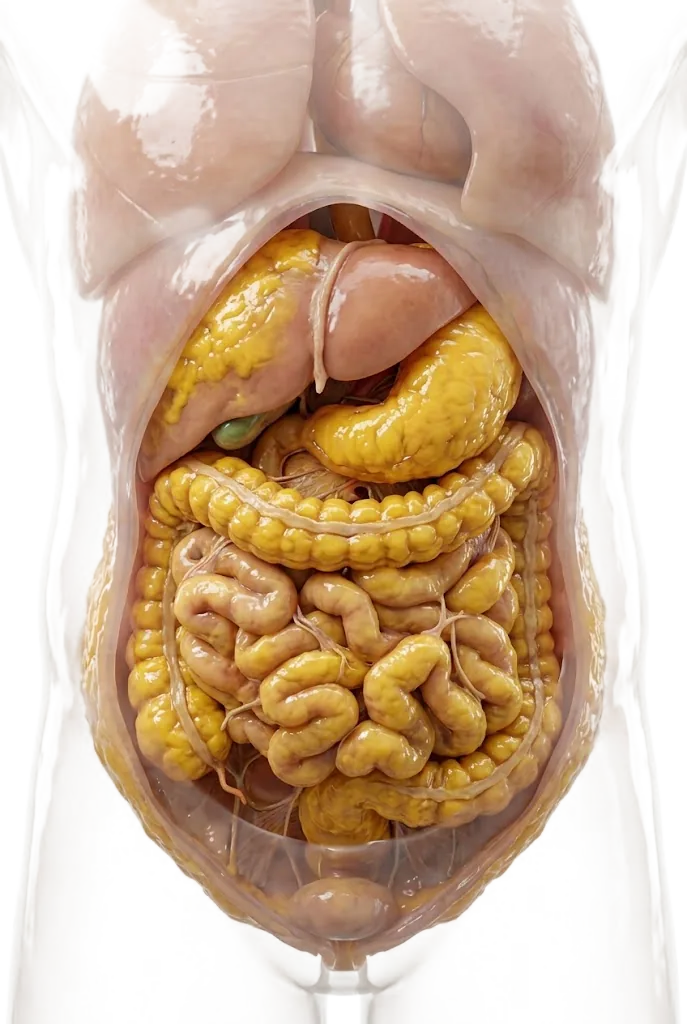
- Fat inside the abdomen: Fat stored between the organs (visceral fat) releases fatty acids and inflammatory messengers into the blood. These disrupt the insulin signal in muscle and liver.
- Fat in muscle and liver: Fat derivatives building up inside cells directly block the insulin signalling chain.
- Inactivity: Muscle is the largest user of blood sugar. Unused muscle becomes less sensitive to insulin.
- Poor sleep and irregular rhythm: Short and broken sleep can reduce insulin sensitivity.
Diabetes in the family and older age also raise the risk. Cortisone-type medicines and excess cortisol can cause insulin resistance as well.
Which conditions is it linked to?
Insulin resistance is closely linked to type 2 diabetes, high blood pressure, abnormal blood fats (high triglycerides, low HDL), fatty liver and hardening of the arteries (atherosclerosis). This cluster is also called "metabolic syndrome". It matters for vascular health, because it lays the ground for leg artery disease and heart attack.
How is it detected?
The first clue is often waist size. Routine tests look at fasting blood sugar, HbA1c, triglycerides and HDL cholesterol. Some people develop darkened, velvety skin on the neck and in the armpits (acanthosis nigricans).
The HOMA-IR index, calculated from fasting sugar and fasting insulin, is widely used in research. Its value varies from one laboratory to another, so it does not make a diagnosis on its own.
What can be done?
In 3,234 people with prediabetes, a lifestyle programme reduced progression to type 2 diabetes by
0%
. With metformin the reduction was 31%.
Targets were at least 7% weight loss and at least 150 minutes of physical activity a week; average follow-up about 3 years.
Knowler WC et al. Reduction in the incidence of type 2 diabetes with lifestyle intervention or metformin.
N Engl J Med 2002;346(6):393-403. doi:10.1056/NEJMoa012512
- Movement: Regular walking and muscle-strengthening exercise increase sugar use by muscle. More: Movement and exercise.
- Weight and waist: Losing even 5-7% of body weight makes a meaningful difference.
- Diet: Cutting processed carbohydrates and sugary drinks; eating more vegetables, legumes and fibre. More: Nutrition and metabolic inflammation.
- Sleep: Regular, sufficient sleep. More: Sleep optimization.
- Medication: If needed, your doctor may start medicines such as metformin.
References
- Petersen MC, Shulman GI. Mechanisms of insulin action and insulin resistance. Physiol Rev 2018;98(4):2133-2223. doi:10.1152/physrev.00063.2017
- Kahn SE, Hull RL, Utzschneider KM. Mechanisms linking obesity to insulin resistance and type 2 diabetes. Nature 2006;444(7121):840-846. doi:10.1038/nature05482
- Reaven GM. Banting lecture 1988. Role of insulin resistance in human disease. Diabetes 1988;37(12):1595-1607. doi:10.2337/diab.37.12.1595
- Matthews DR et al. Homeostasis model assessment: insulin resistance and beta-cell function from fasting plasma glucose and insulin concentrations in man. Diabetologia 1985;28(7):412-419. doi:10.1007/BF00280883
- Knowler WC et al. Reduction in the incidence of type 2 diabetes with lifestyle intervention or metformin. N Engl J Med 2002;346(6):393-403. doi:10.1056/NEJMoa012512
This page is for information only; diagnosis and treatment require an examination.